About the group leader
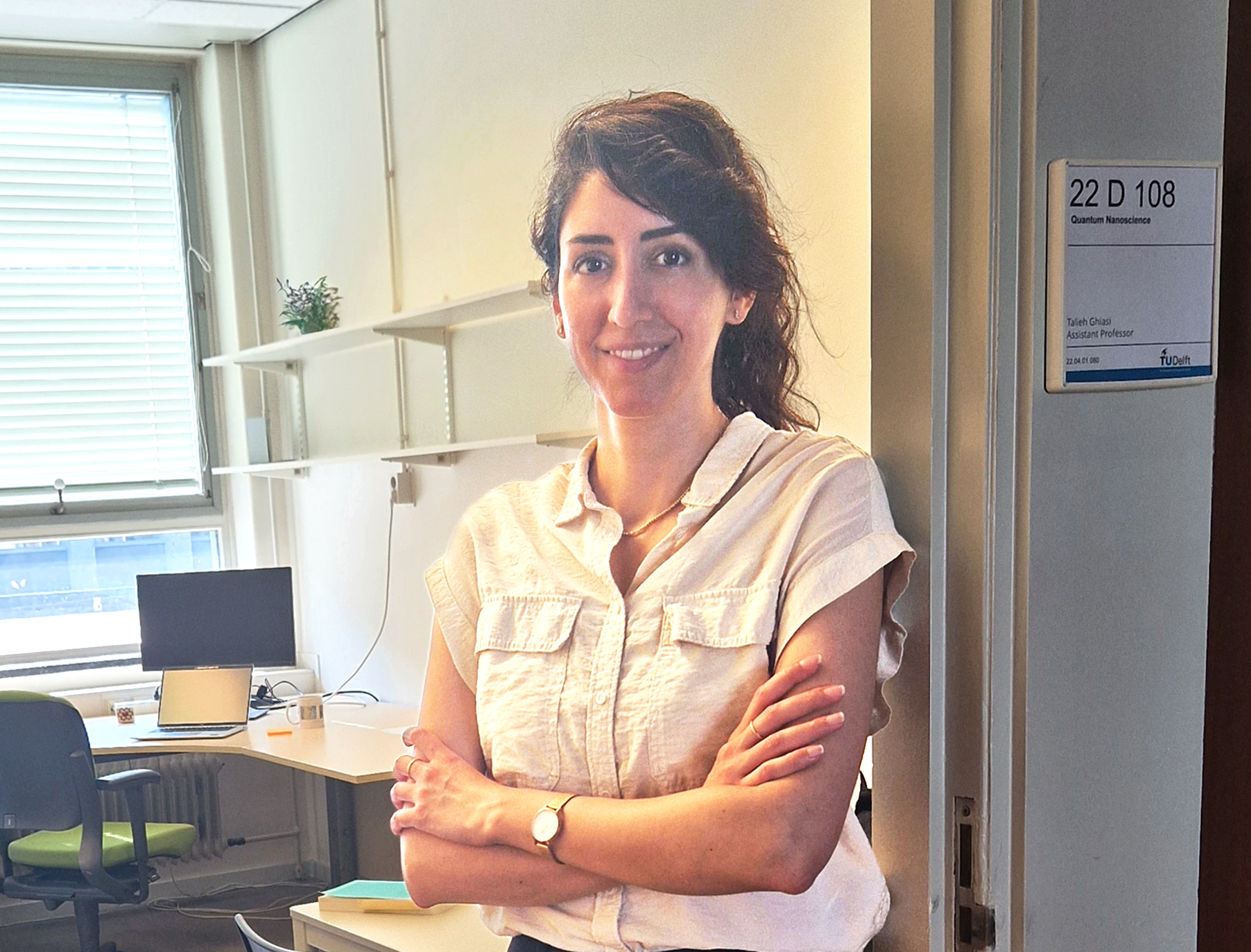 Talieh Ghiasi is an assistant professor at the Department of Quantum Nanoscience at TU Delft and the leader of the Quantum Spintronics (QuSpin) Lab. Her research explores how the quantum properties of electrons, especially their spin, can be used to create new types of low-power electronic and quantum devices based on two-dimensional materials.
Talieh’s scientific journey started in solid-state physics, with a second master’s degree in Nanoscience. Driven by the idea of making information technologies faster, smaller, and more energy efficient, she joined the van Wees lab at University of Groningen for her PhD research, where she began working at the interface of graphene, spintronics, and quantum transport.
During her PhD, Talieh developed expertise in fabricating ultra-thin nanodevices made from two-dimensional materials. By combining graphene with other atomically thin crystals, she showed that graphene’s spin transport properties can be dramatically modified and get enriched by the proximity effect. Her work revealed strong spin-transport anisotropy, new charge-to-spin conversion phenomena, and electrically and thermally generated spin currents in magnetic graphene-based heterostructures. In 2021, she received her PhD degree wit the highest distinction, cum laude, awarded to the top 5% of PhD candidates in the Netherlands.
Talieh then moved to TU Delft for postdoctoral research in the group of Prof. Herre van der Zant, where she brought spin transport in magnetic graphene to the quantum regime. There, she detected quantum-coherent spin-polarized currents in graphene-based nanodevices, which is an important step toward future quantum spintronic circuits. She also expanded her research into new directions, including NV magnetometry of two-dimensional magnets, graphene nanoribbons, quantum point contacts, and optical studies of magnetic van der Waals heterostructures through collaborations at TU Delft and abroad.
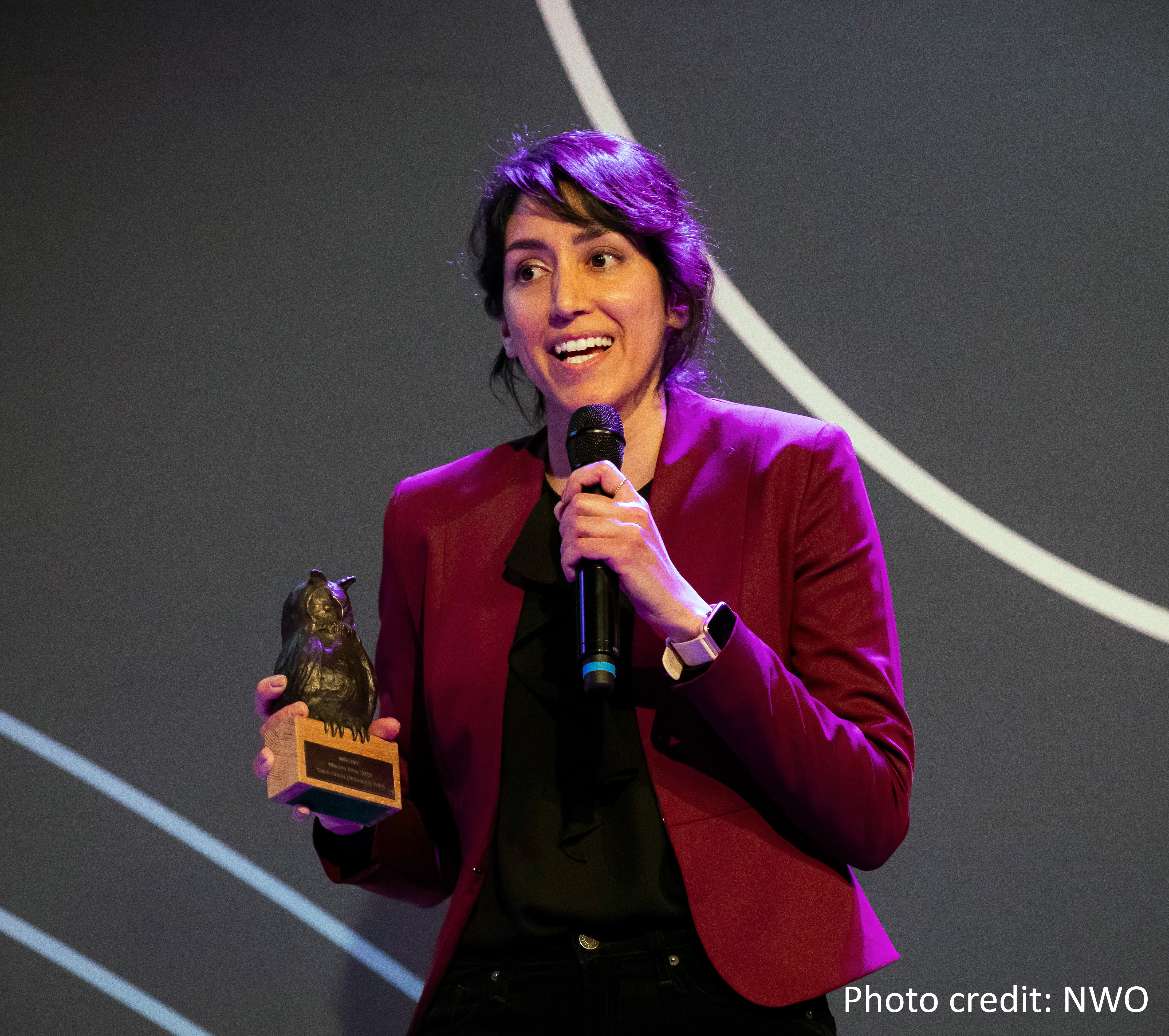 Her contributions to spintronics and two-dimensional magnetism have been recognized through several awards and invitations. Talieh has given invited talks at major international conferences and workshops, including the APS March Meeting, Graphene and 2D Materials, JEMS, Gordon Research Conference, MMM-Intermag, Graphene 2025, and MRS. She received the Best Oral Presentation Prize at the Zernike Conference in 2019, the International Best Speaker Award at Nano 2022 in Spain, and the Minerva Prize in 2023, awarded annually to the most promising female physicist in the Netherlands.
In 2023, Talieh was awarded an NWO Rubicon grant to pursue research on quantum spintronics at Harvard University in the Kim lab. In 2025, she received an NWO Veni grant to develop topological spintronic devices. In August 2025, she returned to TU Delft as an assistant professor to establish the QuSpin Lab, where her team investigates how two-dimensional materials can be engineered into building blocks for future quantum technologies.
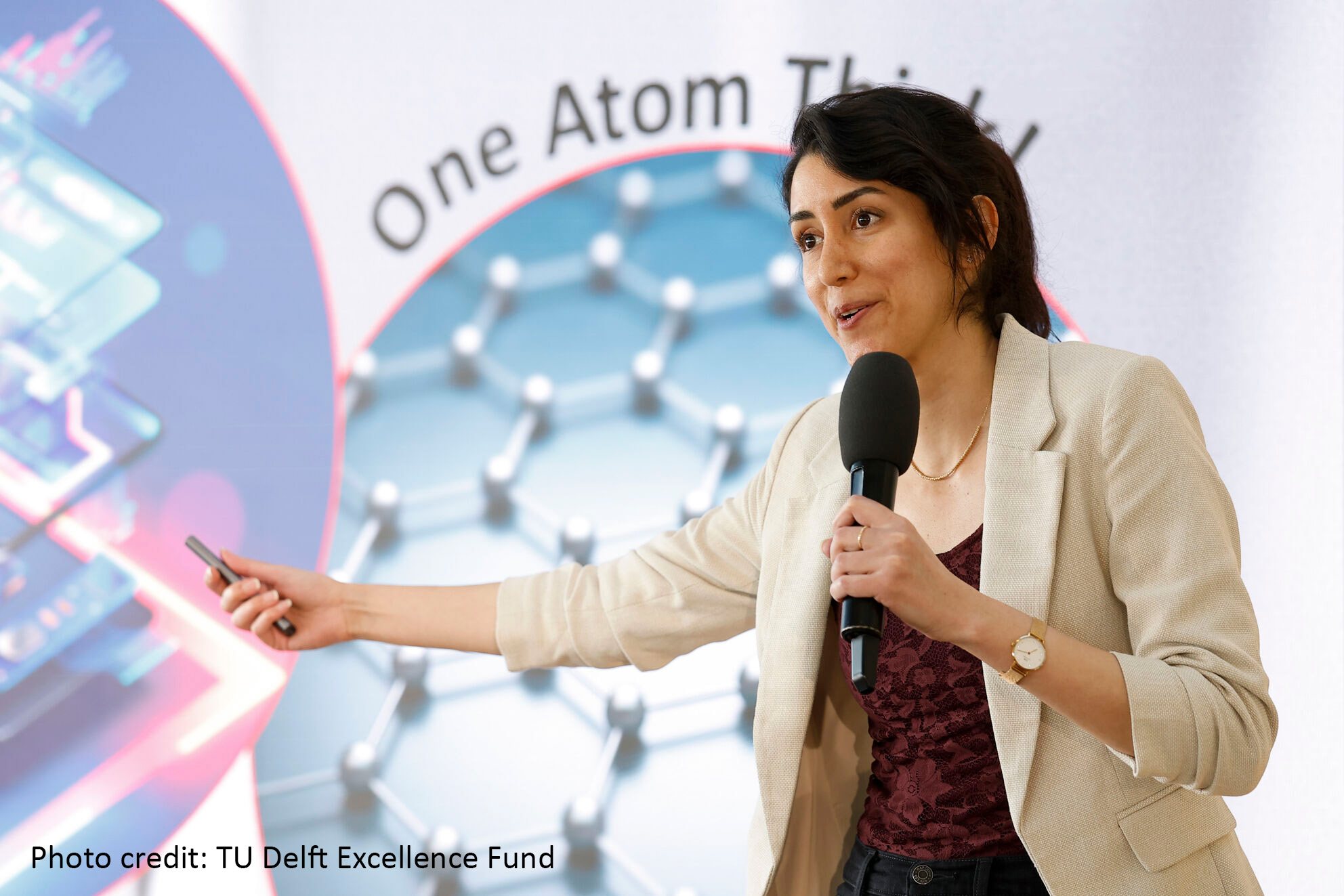 Alongside research, Talieh is passionate about teaching, mentoring, and sharing the excitement of quantum physics with broader audiences. She has been involved in teaching for more than ten years, from tutoring pre-college students in physics to teaching bachelor’s and master’s courses in solid-state physics, mechanics, mesoscopic physics, spintronics, and low-dimensional devices at the University of Groningen, TU Delft, and Harvard University.
Talieh is also strongly committed to science outreach and public engagement. She enjoys bringing complex ideas in spintronics and quantum technology to life for students, non-specialists, and the wider public. Through invited lectures for student associations, interviews, press releases, science articles, and blog posts, she aims to make academic research more accessible, inspiring, and connected to real-world technological challenges.
At QuSpin, Talieh leads a team driven by curiosity, creativity, and the ambition to build a new generation of quantum spintronic devices from atomically thin materials.